|
|



|
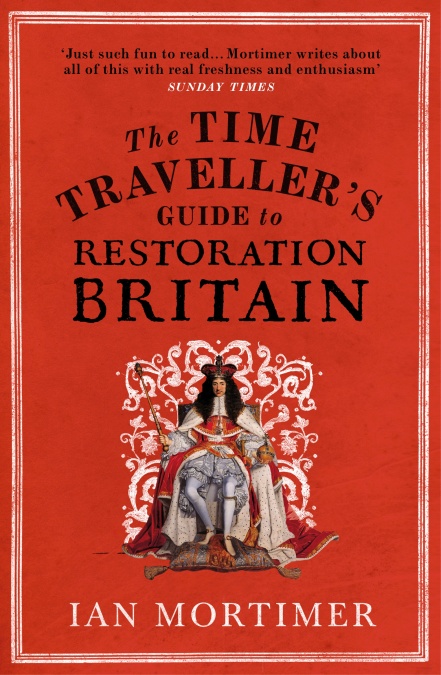
The Time Traveller's Guide to Chapter one (excerpt) It is Sunday, 2 June 1661 - and it is raining hard. Water trickles into puddles in the muddy alleys and swells in the drains that flow down the middle of the cobbled streets. Most people have returned from church to eat their dinner, peering out through windows spattered with raindrops as the church clocks of the city chime a dull midday. The few who are still braving the weather stride along beneath the overhanging jetties of the houses, hunched in their bedraggled hats and cloaks. They glance up at you as they approach: those gentlemen who are worried about their expensive clothes turn their shoulders to the wall to keep to the driest path, forcing you to step away from it. A horse-drawn coach speeds past, its wheels clattering over the uneven stones and sending water flying from the puddles. A stray dog hurries out of its path. But although you may find the weather inclement, there is a reason why you are out and about. This is when you get the clearest view of the city. Normally there are just too many carriages and people in your way. And that's not to mention the pollution. Some days a pall of smoke hangs over the roofs: it gets in your eyes, and the stonework of every church in the city is blackened with it. Today the houses might be dripping from the eaves but at least you can see them. When you walk through the heart of London you realise that the city is practically a living museum. It is not that the citizens are careful to preserve old structures, but rather that they are reluctant to pull them down. Almost every building you see is old. On the east side you have the Tower of London, the stern castle of the Norman and Plantagenet kings of England, which is now a storehouse for gunpowder and armaments and a prison for high-ranking figures. To the north of the Tower is the city wall, first built by the Romans and subsequently heavily patched, but still standing in most places to its battlement height of 18 feet. The wall encloses a mass of medieval streets, lanes and alleys, twisting and weaving intricately around old houses and churches. Some of the streets are too narrow to allow two coaches to pass, and some of the alleys so tight that even a single vehicle cannot enter. Thames Street, one of the busiest thoroughfares of the whole city, has pinch points just 11 feet wide, where traffic frequently comes to a stop. Many of the houses are several hundred years old, their blackened oak timbers deeply scarred with the fissures of so many seasons. The rat holes in their walls are similarly ancient and, like the houses themselves, are teeming with life. The older properties have been modernised with glass windows but they preserve their essential character, the first floor projecting out about 18 inches over the ground floor, and the second jettied out about a foot over the first, with a gabled roof facing the street. On narrow alleys, the occupants of second-floor chambers can reach out and touch hands with their opposite numbers on the other side. Such jetties block out much of the light, so they make the alleys dark at the best of times; on grey days such as today they are particularly dim. Grand old stone mansions are still to be found on the principal streets, their halls now heated by fireplaces and tall brick chimneys. But even the terraces of four-, five- and six-storey town houses date from between sixty and a hundred years ago. What's more, if you take just a few steps down one of these dark alleys, you'll see that tucked in behind these tottering edifices are older structures divided up into tenements without any regular plan. Here's a chamber above a kitchen, there's a chamber above a hall. Many of these were once the buildings of medieval monasteries and friaries. Even old barns have been turned into houses. As you can see, London has developed not by being demolished and rebuilt but by constantly adapting, little by little, to people's changing demands. Even if you are familiar with the modern city, you will not recognise much here. The Tower may look more or less the same, but the other structures are all very different from their modern successors. The tall limestone obelisk bound with iron on the south side of Cannon Street is an ancient landmark called London Stone. Some people will tell you it was erected by King Lud, the mythical founder of London; others that it was the stone from which all milestones in Roman Britain measured their distances from the capital. Moving north to Cornhill, you will find the Standard, the great conduit that provides the citizens hereabouts with water. On the north side of the street you will see a fine old building of four arcades around a quadrangle: this is the Royal Exchange, built by Sir Thomas Gresham and named by Queen Elizabeth in 1571. You can see statues of all the kings and queens since the Norman Conquest in the niches above the arcades. Sometimes you'll hear the Royal Exchange described as the most valuable three-quarters of an acre in the world, due to the trade carried on here, but on a wet Sunday afternoon it feels more like a sepulchral monument, dripping with raindrops and absence. Nearby is one of the city's pillories, where trading offenders are publicly humiliated with their heads and hands trapped between wooden boards; today that too is as damp and silent as the puddles welling up across the courtyard of the Exchange. Everything appears ancient - from the seven medieval gates of the city, to the livery halls of the powerful guilds and the Guildhall itself, built in 1411. Some of the finest merchants' and goldsmiths' houses are to be seen on Cheapside, the main trading street, but these too are almost a century old. The buildings on the southern edge of the city, where the waters of the River Thames lap at the quays, are similarly venerable. If you can turn your attention away from the vast number of ships on the river you'll see the waterline marked by a whole gamut of antiquated and decrepit walls and roofs. Here is London's second royal fortress, the gaunt Baynard's Castle, rebuilt in the fifteenth century and remodelled at the start of the sixteenth. Further along the bank are the weather-boarded and pitch-covered warehouses of merchants whose ships have been returning for the last forty years with cargoes of Virginia tobacco or spices from the East Indies. On a weekday the rain would not have stopped the three wooden cranes on the wharf at Queenhithe from loading and unloading the tuns of wine but, today being Sunday, they too are motionless. Further along the river still is the Steelyard, where the merchants of the Hanseatic League have had their trading centre for the last seven centuries. They are no longer the powerful economic force they once were, and the old buildings are now sinking into decay. The most striking structure along the river is London's only bridge, built in the twelfth century. It stands 910 feet long and connects London proper with its southern suburb of Southwark and the roads leading into Kent, Surrey and Sussex. Each of its nineteen arches has a name, such as 'Queen's Lock', 'Narrow Entry', 'Rock Lock' and the charmingly named 'Gut Lock'. These arches are built on boat-shaped starlings or piers in the water, forcing the fast-changing tides to gush through the channels between them. The roadway of the bridge is lined with houses that peer over the turbulent flow. At the southern end is the medieval gatehouse, where about two dozen decayed heads and skulls are to be seen - these being the remnants of traitors, placed there as examples to the citizens. At the northern end there is a gap between the houses, following a major fire in 1633. It is ironic that the most significant modern change to the bridge is an empty space. Gradually you will realise that there is almost nothing visible that dates from the seventeenth century. Here and there you'll see a modern house, built where a fire has destroyed a dwelling, but two-thirds of the buildings within the city walls are medieval and almost all the rest are Elizabethan. Leathersellers' Hall has an impressive portico dating from the 1620s. Denmark House, the queen's royal palace designed by the royal surveyor, Inigo Jones, has some fine modern additions: a suite of royal apartments, new stables and coach houses. Otherwise, very little in the heart of the city post-dates 1600. The most significant piece of seventeenth-century architecture within the city walls is a 120ft-wide portico with Corinthian columns, which has been added to the west end of St Paul's Cathedral. This too is the work of Inigo Jones. But just look how incongruous it appears, forced on to the massive church, whose high lead roofs look black and gloweringly gothic in the rain. Note too the contrast between Jones's work and the worn sculpture of the masonry of the nave. One hundred years ago, lightning struck the tower and, in the ensuing fire, the spire collapsed; it has not yet been replaced. Shops and stalls have been constructed at the foot of the cathedral's soot-blackened stone walls, between the mighty buttresses. When you step inside, you'll see the pillars on either side are all out of alignment, sometimes leaning by more than six inches, even though they are a solid-looking 11 feet in diameter. Hundreds of monuments of London dignitaries and noblemen fill the spaces between the columns and cover the walls; among them King Ethelred the Unready, John of Gaunt, Sir Nicholas Bacon, Sir Francis Walsingham, Sir Philip Sidney, Sir Christopher Hatton, John Donne and Anthony van Dyck. Many have been defaced by vandalism or accidents. Much of the damage is a result of the Civil Wars, when the cathedral served as a stable for more than 800 horses - a sign of the contempt that Cromwell's forces had for the old religion. At the same time the choir stalls, bishop's throne and organ were destroyed, and saw-pits were dug in the floor. When a committee visits the cathedral in 1666 with a view to improving and updating it - and Christopher Wren first suggests topping the whole edifice with an enormous baroque dome - its members sadly conclude that the old building just won't take the strain. This then is the heart of London: a decaying mass of antiquity, adaptation and dilapidation, collapsing beneath the weight of its age. However, step beyond the city walls and into the suburbs and you will be amazed by the difference. First, pinch your nose and walk past the old warehouses and collapsing timber buildings that surround Fleet Ditch. As you cross the bridge over the River Fleet you will see all sorts of refuse floating in the swollen river below: 'sweepings from butchers' stalls, dung, guts, and blood, drowned puppies, stinking sprats, all drenched in mud, dead cats and turnip tops'. Keep going westwards up Fleet Street; as you approach the bottom of Drury Lane and enter the area that will one day be called the West End, you will find yourself surrounded by tall flat-fronted houses that are made of fine red-brown bricks, with tall glass windows facing the streets. Between the windows are elaborate classical columns. The doorways are recessed and covered with elegant canopies and have glass panels above the doors to let light into the hallways within. Whole streets stand to a uniform height, so that ten or twelve town houses look more like a great palace than a series of private dwellings belonging to individual gentlemen and 'men of ability' (as contemporaries refer to the upwardly mobile). The eaves of these do not drip on a rainy day such as this, because they have gutters and downpipes that conduct the roof water into the streets. And, just as significantly, the streets themselves are not cobbled or dressed with gravel, but paved. They even have a camber, so that the rainwater does not run into a channel in the middle but into gullies on the sides, adjacent to a raised pavement. Here, on the edge of the old city, the elegant town house has arrived. What has brought on this transition? One of the reasons is simply the massive growth of London's population. In 1550, there were about 50,000 Londoners. That number quadrupled to about 200,000 in 1600. It almost doubled again over the next fifty years, reaching about 375,000. Since 1650 it has increased by another 10 per cent, and now in 1661 stands at about 410,000. But the population increase only accounts for the need to provide more housing; it does not explain the change in the standard of architecture. For this you need to consider the attitude of the English monarchs, who reside at Whitehall Palace, at the end of the Strand. Queen Elizabeth I forbade the expansion of the city to the west of Drury Lane, just over half a mile from the palace. Her successors have similarly attempted to restrict all house building to previously developed sites. They have failed - partly because they have allowed the lords who own the land west of Drury Lane to buy licences to build on virgin soil, and partly because such fine new houses are now considered to contribute to 'the honour of the nation' and thus fall outside the scope of restrictive legislation. In other words, new houses in this area are not illegal as long as they are for the wealthy. But as these new buildings creep closer and closer to Whitehall, the royal family becomes more and more anxious about their architecture. Proclamations are issued stipulating how high and wide each house should be, how thick its walls, and how each one must fit in with its neighbour and thus form an elegant unity. This is why the lines of new housing look more like palaces than narrow town houses: the kings and their courtiers prefer to be surrounded by elegant buildings rather than the unplanned slums of the riff-raff. The major showpiece is the Covent Garden piazza. The houses here are so different from the timber-framed buildings of the old city that you may be forgiven for thinking you are entering a different country. A wide, paved square greets you, with handsome three-storey mansions around the perimeter. On the south side are the gardens of Bedford House, the London home of William Russell, fifth earl of Bedford, whose father commissioned Inigo Jones to design the piazza in 1631. On the western side you find the parish church, also designed by Inigo Jones, and two brick-fronted town houses built by the fourth earl. To the north and east elegant residences have been developed by a string of private developers, all fronted with a 20ft-high arcade. Given that the fourth earl paid £2,000 to the king for the licence to build the piazza, and spent more than £4,000 on the church and £4,700 on his three town houses, you can see why Covent Garden in 1661 is a byword for high living. Anyone resident in the old heart of the city must feel like the poor relation of those rich enough to live here. Covent Garden marks the beginning of modern town planning in Britain. It inspires many elegant developments to the west and north of the city. No one builds jettied wooden houses any more; everyone wants flat-fronted brick ones, with wide streets, drains, neat gutters and lots of light. Gabled roofs are out - people want pilasters with Corinthian or Ionic capitals and balustrades along the roof. Most of all, those with money want to live in a well-proportioned square. Near Holborn, Lord Hatton has laid out Hatton Garden as a handsome street with a square of fine town houses at one end. Even more impressive are the recent developments in Lincoln's Inn Fields and in Great Queen Street, both built by William Newton. The Dutch artist Willem Schellinks, who visits London in 1661, describes Lincoln's Inn Fields as 'a large square lying behind Lincoln College, where law students are taught. Round this square are many fine palace-like houses, all with forecourts behind high walls; one can count there seventy entrances with stone pillars and double doors, and many of the nobility live there.' A few years later, Lorenzo Magalotti, a Florentine nobleman travelling in the train of the Grand Duke of Tuscany, Cosimo III, adds his words of praise, calling Lincoln's Inn Fields 'one of the largest and handsomest squares in London, in respect to both the uniformity and size of its buildings'. If your architect manages to impress both the Dutch and the Florentines - two of the most urbane and sophisticated people in Christendom - then you are creating quite an impression. As a result of this, there are really two Londons: the old and the new. The old is largely confined within the ancient city walls and in the areas immediately outside the gates, as well as the suburb of Southwark, on the south side of the river. The new London envelopes the old, running from Spitalfields in the north-east across to Hatton Garden - including the new developments to the south of Theobalds Road - and as far as Piccadilly. But the new city is not stopping there: if you walk all the way around the perimeter, you will see a great deal of building work under way. Southampton Square (better known to you as Bloomsbury Square), laid out by the earl of Southampton in 1660, is currently being developed as a piazza of high-quality houses. Although it is still possible to see 'the Lines of Communication' - the half-moon defences constructed to defend London during the Civil Wars - these will soon disappear under the new streets. At the south-west extreme of the conurbation, the palaces of Whitehall and Westminster still sprawl in all their medieval angularity, but you cannot help but feel it is only a matter of time before these too are engulfed in the great tide of construction that is lapping at the city walls. The heavy rain does not abate all day. In his house in Seething Lane, to the north of the Tower, Samuel Pepys looks out at the downpour. He is the Clerk of the Acts, one of the most important positions in the administration of the navy, and a prosperous man with interests in a great many subjects, including scientific innovations. However, having already spent a couple of hours drinking wine and eating anchovies with Ralph Greatorex, a maker of mathematical instruments, he has had enough of discussing the mathematical properties of levers. He is now wishing the rain would stop, so the man could go. But if you come back to call on him the following Thursday, when the weather is fine and warm, you'll find him in a much better frame of mind, sitting on his roof terrace with his neighbour, Sir William Penn, playing his lute and drinking wine (again). And on that sunny day the old city will give you quite a different experience from the wet Sunday you have just seen. Although the heat means that there are few domestic fires burning, the many industrial ones around the city make the air acrid with the smell of coal smoke. But it is not just burning coal that will affect your nostrils. You will gag on the noxious fumes coming from the riverside and those parts of the city where tanning and fulling take place. In the main streets, the piles of dung left by the horses also emit an aroma. So do the splashes of urine where men have pissed in alleyways. As the heat of the day intensifies, these smells tend to be overpowered by the stench of the cesspits in the cellars. Pigeons fly out from under the eaves of the old houses, their droppings leaving a white streak on the timberwork. Rats scavenge behind barrels and under and over crates. Kitchen rubbish collectors lead their horse-drawn carts from door to door, collecting rotting matter. Rakers, whose business it is to empty private cesspits, lead their horse-drawn carts filled with dung-pots through the streets. Flocks of sheep and herds of cattle are driven on the hoof to the abattoirs and meat markets, where their dung and their blood add to the stink of the street. You could say that walking through old London is still the same multi-sensory experience it was in the Middle Ages. In fact, it is even more overwhelming, due to the larger population. Ten times as many people live here these days as did in the late fourteenth century, and that means ten times as many sheep and cattle, and ten times as much human waste. And it is not just the permanent residents who contribute to the sense of overcrowding: hundreds of thousands of people come into town daily for business or pleasure - to go to market, attend a fair, do business in the city or see a play at one of the theatres. As a result, there are crowds of people and animals everywhere you go. Just listen to the sounds of a London street. More than 3,000 oxen are led into the city and slaughtered here every day, besides a huge number of other animals. The noise they make as they pass by or wait in pens is considerable; their squeals, bleats and bellows as they are being slaughtered are raucous and disturbing. Then there is the sound of the iron-shod wheels of more than 2,000 coaches, and many more thousands of carts and wagons, grinding over the cobbles of the old streets, and the metallic hammering of blacksmiths and candlestick makers. When the traffic grinds to a halt because too many coaches are simultaneously trying to pass the same point, you will hear loud altercations between the drivers. You will hardly be able to avoid the bells and loud clappers of the rakers driving their dung-carts, with which they announce their presence. Nor will you be able to ignore the yelling of those gathering around a cockfight or wrestling match in the streets, especially if many bets have been placed. If you then add the hourly chimes of more than a hundred churches, the cries of street vendors pushing their way through the crowds - 'Mackerel, two a groat and four for sixpence', 'Flounders, buy my flounders', 'Frying pans mended' - and the calls of householders leaning out of their upstairs windows, trying to attract the attention of the sellers in the street, you can see that old London is not just so crowded and smelly: it is also so loud that you can barely hear yourself think. If you are looking to escape the hubbub, there are gardens and parks laid out for recreation. This is a new cultural aspect of the city: a hundred years ago the urban centre was the main and only attraction, and if you needed to renew your connection to nature, you could go for a stroll into the fields. The idea of a horticultural experience was something that only occurred to gentlemen who installed pleasure gardens in their country houses. But these days Londoners increasingly feel the need to leave the congested streets, if only temporarily. Those who can afford it might take a coach to Hyde Park, to wander in the grounds or follow the parade of other fashionable coaches around its perimeter. If you're on foot, you might saunter over to St James's Park where you can enjoy a long, straight walk between the lines of mature elms, along the path known as the Mall, and, at the same time, watch the aquatic birds on the nearby ornamental canal. On the north side, beyond St James's Palace in what will one day become Green Park, you will find a woodland where people come to see deer; and on the southern side of the park is the royal aviary, Birdcage Walk. Another fashionable option is to take a boat to Vauxhall to see the New Spring Gardens. These are a series of covered walks among flowerbeds, where people stroll up and down or stop at huts where they can buy an overpriced glass of wine or beer, for which there are long queues. At this time of year it is very pleasant to wander there gathering roses or pinks and then return to the city by a wherry, trailing your fingers in the water as the waterman guides you to the nearest 'stairs' or small dock, from which you can walk home. At the end of the evening, London undergoes yet another transformation. The commotion dies down, the colour fades from the streets and the traffic dwindles. In the public gardens the decent and self-respecting people withdraw and less-respectable characters make their shadowy appearances. If you go for a walk among the tall elms in St James's Park by night, you are entering a different world. In the words of the poet John Wilmot, earl of Rochester:
All this should give you some idea as to why people's opinions of London are so wildly divided. For those who were born here, London is not just a city, it's everything that life promises. It's a religion, a mythology, a law and a tradition. It's a great experiment in how to live and, as such, it contains all that is good and bad about life. Ask any Londoner what he thinks of the place and he will tell you that it is the flower of all cities. Richard Newcourt declares in his new map of London (published in 1658) that London is 'the most magnificent and renowned city in Europe, both for the antiquity of her foundation as also for honour, wealth and beauty'. John Brydall in his Camera Regis (1676) states that London 'is styled the epitome or breviary of all England, the seat of the British Empire, the king of England's chamber'. Foreigners readily agree with such pronouncements, largely because of the sheer size of the place. The number of ships moored in the Thames always grabs their attention, with estimates ranging from 1,400 to 2,000 vessels at various times. But visitors also pass negative comments. Most agree that sprawling Whitehall is not only the largest palace in Europe but also the ugliest. Lorenzo Magalotti admits that no city in the world has so many fine shops, but is unimpressed by most of London's public buildings - except for the Tower of London, the Banqueting Hall in Whitehall Palace (designed by Inigo Jones), Westminster Hall and St Paul's Cathedral. He also cannot reconcile being held up by the heavy traffic on London Bridge with the idea of a modern city. Monsieur Misson, a French gentleman who spends some time in England, declares the houses of old London to be 'the scurviest things in the world . . . nothing but wood and plaster and nasty little windows'. And, dare it be said, some English writers also voice their complaints about the state of the metropolis. Daniel Defoe describes the Fleet as 'a nauseous and abominable sink of public nastiness'. John Lanyon gives a fuller account of the city's unsavoury features, declaring that:
In the early hours of Sunday, 2 September 1666, the king's baker Thomas Farynor wakes up in his house in Pudding Lane to find himself choked by smoke. He sees flames rising rapidly up his staircase. Rousing his son, daughter and maidservant, he tells them to climb through an upstairs window. The maidservant refuses, too scared of heights, and remains in the house. He therefore leads just his children along the edge of the roof to the safety of their neighbour's house. The maidservant becomes the first victim of the Great Fire of London. |
 |
 |
 |
 |